Peptide Synthesis Overview
Learn the fundamentals of peptide synthesis and solid-phase peptide synthesis (SPPS), including resin-bound peptide assembly, amino acid coupling, deprotection, chain elongation, and final cleavage. This overview explains the basic chemistry and workflow behind modern synthetic peptide production.
Peptide synthesis is the stepwise assembly of amino acids to produce a defined peptide sequence. Synthetic peptides are widely used in biochemical research, antibody development, assay development, drug discovery, and studies of peptide structure and function.
Modern peptide production is most commonly performed using solid-phase peptide synthesis (SPPS), which allows amino acids to be added sequentially while the growing peptide chain remains attached to a solid support.
What Is Solid-Phase Peptide Synthesis (SPPS)?
In SPPS, the first amino acid is attached to a solid-phase resin through its C-terminus. Additional amino acids are then coupled one at a time to extend the peptide chain from the C-terminus toward the N-terminus.
The solid support makes it possible to remove excess reagents and reaction by-products by washing the resin between synthesis steps. This simplifies repeated coupling and deprotection cycles and makes SPPS well suited for automated peptide synthesis.
How Does SPPS Work?
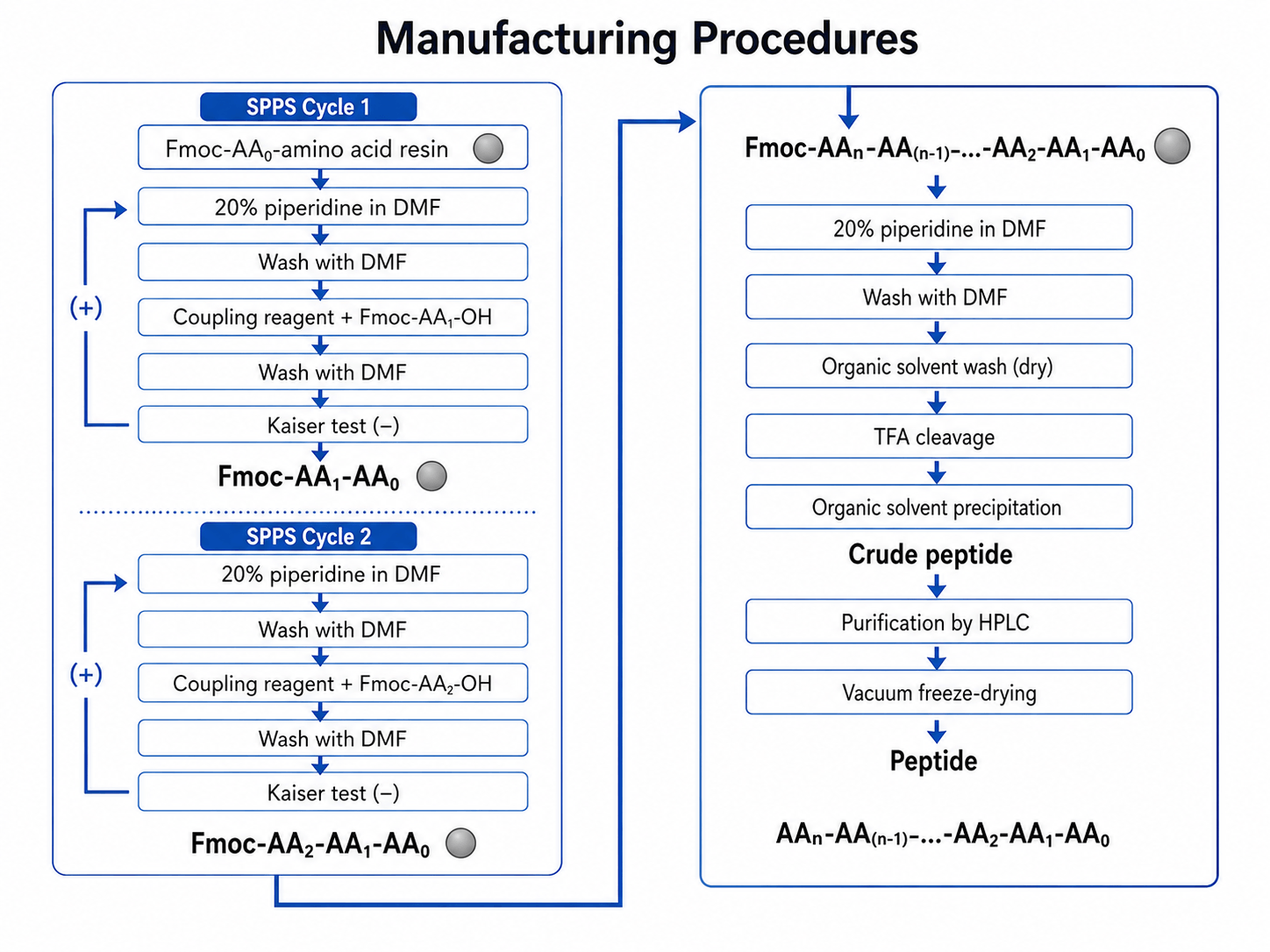
A typical peptide synthesis cycle includes several basic steps:
1. Resin Loading
The first amino acid is attached to a suitable peptide synthesis resin.
2. Deprotection
A temporary protecting group on the amino terminus is removed to expose the reactive amine. In modern SPPS, Fmoc chemistry is commonly used for this purpose.
3. Amino Acid Coupling
The next protected amino acid is activated and coupled to the growing peptide chain through formation of a peptide bond.
4. Repeated Chain Elongation
Deprotection and coupling are repeated until the complete amino acid sequence has been assembled.
5. Cleavage and Deprotection
After synthesis is complete, the peptide is cleaved from the resin and side-chain protecting groups are removed, typically using an acid-based cleavage system.
The resulting crude peptide can then proceed to purification and analytical characterization according to the required final specification.
Fmoc-Based Peptide Synthesis
Fmoc (9-fluorenylmethoxycarbonyl) is one of the most widely used N-terminal protecting groups in SPPS.
Fmoc protection is compatible with a wide range of side-chain protecting groups and allows the N-terminal protecting group to be removed under basic conditions while acid-sensitive side-chain protection and resin linkers remain intact during peptide assembly.
A broad selection of Fmoc-protected amino acids, including standard, D-form, and non-natural amino acid building blocks, can be used to construct peptides with different sequences and chemical properties.
From Peptide Sequence to Synthetic Peptide
Although the basic SPPS cycle is straightforward, synthesis performance can vary considerably between peptide sequences. Peptide length, hydrophobicity, amino acid composition, aggregation, and chemical modifications can all influence coupling efficiency and overall synthesis difficulty.
For custom projects, synthesis strategy can therefore be adjusted according to the individual peptide sequence and intended application.
Learn more about our Custom Peptide Synthesis capabilities or explore the Peptide Synthesis & Chemistry Knowledge Center for more detailed technical information.