Quality Control Report
Alan Scientific provides peptide quality control using analytical HPLC and mass spectrometry (MS) to evaluate peptide purity and confirm molecular identity. Explore representative peptide QC reports and learn how HPLC purity analysis and MS characterization support the quality assessment of synthetic peptides.
Alan Scientific provides peptide quality control and analytical documentation to support the assessment of peptide identity, purity, solubility, and project-specific quality requirements.
Analytical HPLC is used to assess chromatographic purity, while mass spectrometry supports identity assessment by comparing the observed and expected molecular mass. Applicable results are documented in the Certificate of Analysis. Additional testing is specified according to project requirements.
Peptide Quality Control
| Quality Control | What It Evaluates | COA Documentation |
| Mass Spectrometry (MS) | Supports confirmation of the expected peptide molecular mass | MS result / molecular mass information |
| Analytical HPLC | Evaluates chromatographic peptide purity | HPLC purity result |
| Solubility Testing | Evaluates peptide solubility under specified test conditions | Solubility information when requested |
| TFA / Counterion | Supports reduced-TFA or alternative peptide salt requirements | TFA or counterion information when applicable |
| Endotoxin Control | Supports projects requiring controlled endotoxin levels | Endotoxin specification or result when requested |
Mass Spectrometry (MS)
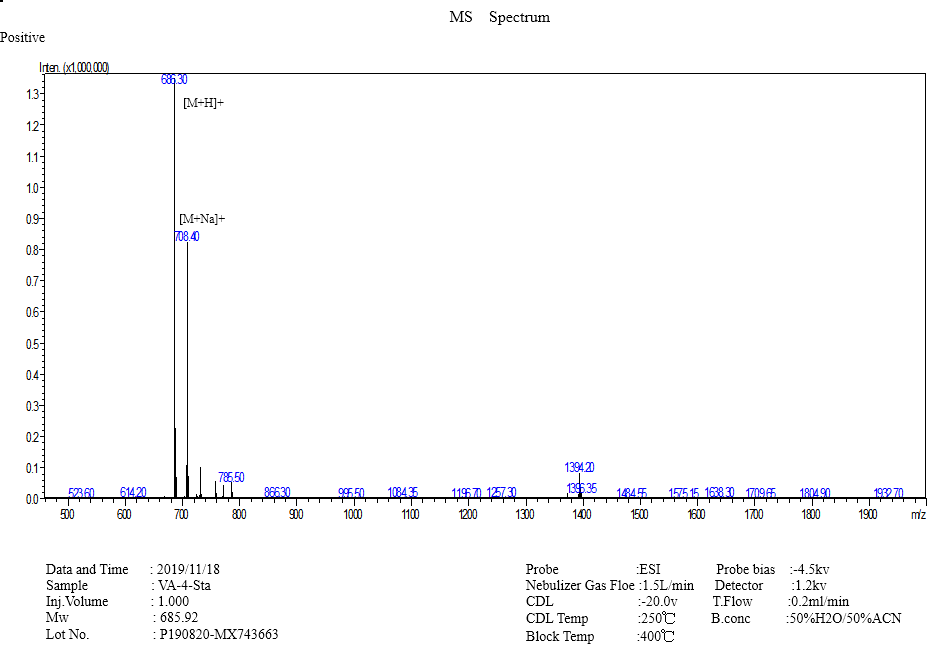
Mass spectrometry is used to support peptide identity confirmation by comparing the observed molecular mass with the expected molecular mass of the synthesized peptide.
MS data are provided as part of the analytical documentation for applicable peptide products.
Analytical HPLC
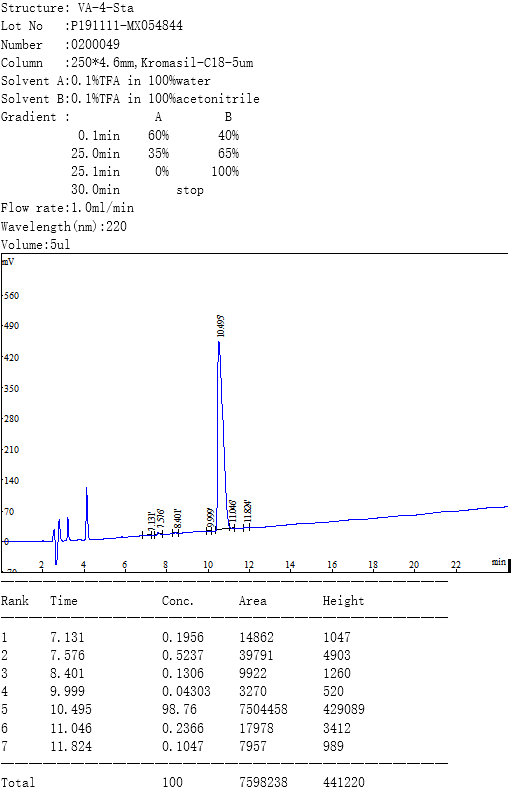
Analytical HPLC is used to evaluate chromatographic peptide purity. The chromatogram shows the relative distribution of detectable components under the specified analytical conditions and provides the reported peptide purity.
HPLC results are included with the applicable peptide quality-control documentation.
Peptide Solubility Testing
Peptide solubility can vary depending on sequence, hydrophobicity, charge, concentration, chemical modification, salt form, and solvent conditions.
Peptide solubility testing is available upon request and can be performed according to project-specific requirements. Relevant solubility information can be documented in the COA when requested.
TFA Removal & Counterion Exchange
For projects where residual TFA or peptide salt form is important, Alan Scientific provides TFA removal and counterion exchange options.
Available options include:
Reduced TFA
Acetate salt
Hydrochloride (HCl) salt
Applicable TFA or counterion requirements can be documented in the final COA.
Endotoxin Control
Endotoxin control is available for peptide projects with specific downstream biological requirements.
When endotoxin testing or a defined endotoxin specification is requested, the applicable result or specification can be included in the COA.
Additional Analytical Services
For projects requiring additional characterization beyond routine peptide QC, selected analytical services can be arranged upon request.
| Optional Analysis | What It Evaluates |
|---|---|
| Amino Acid Analysis (AAA) | Provides quantitative amino-acid composition information and can support peptide content or composition assessment |
| Water Content (Karl Fischer) | Measures residual water content in lyophilized peptide material |
| MALDI-TOF MS | Provides an additional mass-spectrometric option for project-specific molecular mass characterization |
These analyses are not routinely required for most research peptide projects and are generally selected when the downstream study, documentation requirement, or material specification justifies additional characterization.
Availability, sample requirements, turnaround time, and pricing are evaluated on a project-specific basis.
Certificate of Analysis (COA)
The Certificate of Analysis provides a consolidated record of the peptide and its applicable quality-control information.
Depending on the project, the COA may include:
Peptide name or identifier
Amino acid sequence
Modification information
Molecular weight
Peptide purity
HPLC result
MS result
Solubility information
TFA or counterion information
Endotoxin information
Peptide quantity and other project-specific specifications
Quality-control requirements can be specified when placing a Custom Peptide Synthesis order.