AlanMolecularAI™ is an AI-assisted platform for small-molecule generation, analog design, and molecular optimization. Starting from an existing molecule or selected molecular fragment, the platform explores new chemical structures according to user-defined targets, properties, and optimization objectives.
AlanMolecularAI™ combines molecular generation with property prediction, ADMET-related evaluation, structure–activity analysis, and candidate prioritization to help researchers explore chemical space before compound synthesis and experimental validation.
The goal is to transform a molecular starting point into a focused set of computationally prioritized analogs for downstream medicinal chemistry, docking, synthesis, and biological testing.

What Can AlanMolecularAI™ Do?
| Research Need | AlanMolecularAI™ Approach | Output |
| Optimize an Existing Molecule | Explore structural analogs around a starting compound | Prioritized molecular analogs |
| Preserve a Core Scaffold | Select variable and constant molecular fragments | Analogs retaining selected structural features |
| Optimize a Defined Property | Generate candidates according to a selected target and optimization objective | Property-directed molecular candidates |
| Balance Multiple Properties | Compare candidates across molecular and predicted property metrics | Multi-parameter candidate ranking |
| Explore Structure–Activity Relationships | Compare structural changes with predicted molecular properties | Analog series for SAR exploration |
| Prepare Candidates for Further Evaluation | Prioritize selected molecules for docking or experimental testing | Shortlisted compounds for downstream research |
AlanMolecularAI™ Workflow
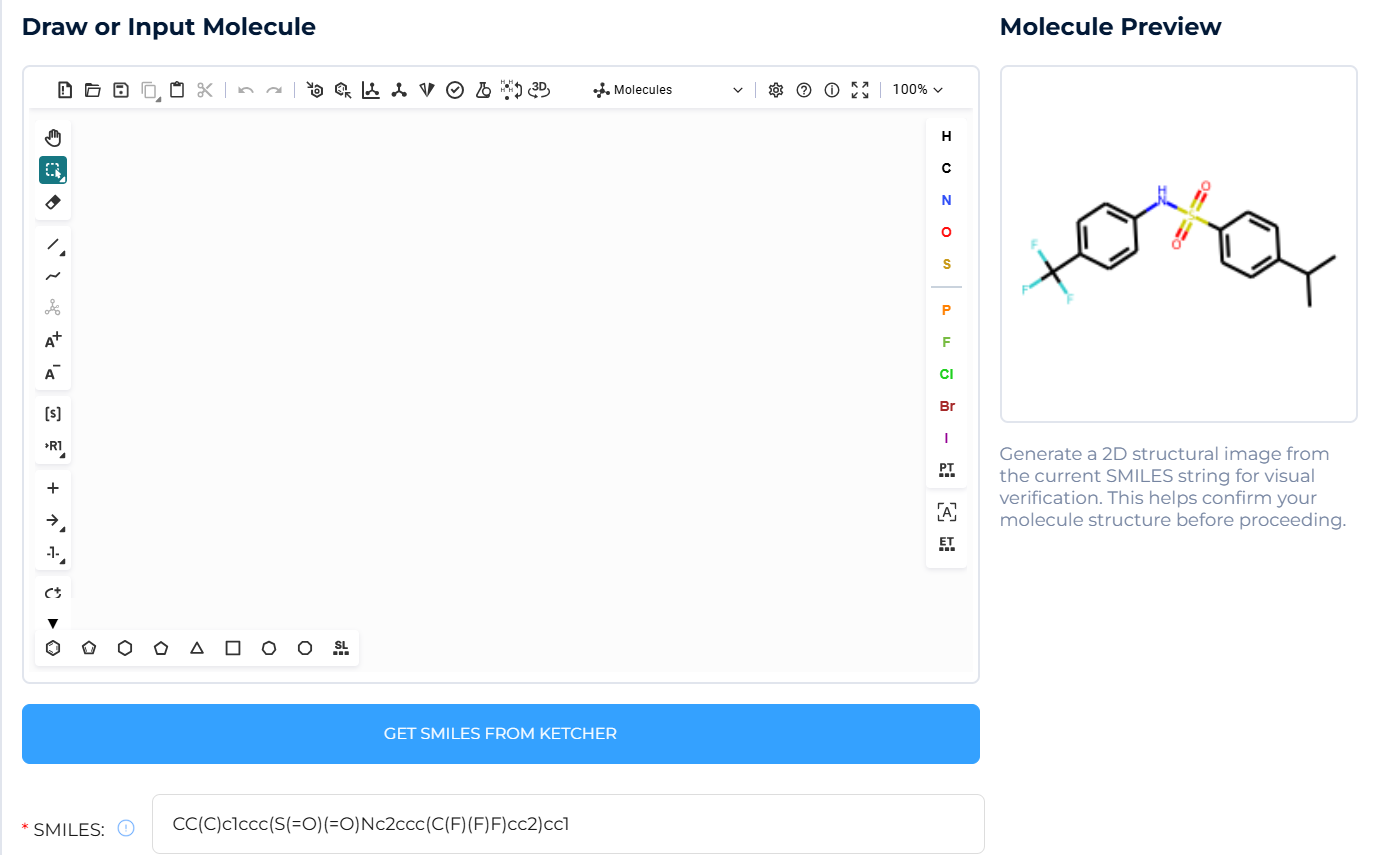
1. Input or Draw a Starting Molecule
A project begins with an existing molecular structure. Users can draw a molecule directly in the platform or provide a molecular structure using SMILES.
The starting structure provides the chemical framework from which new analogs and optimization strategies can be explored.
2. Select the Molecular Region to Optimize
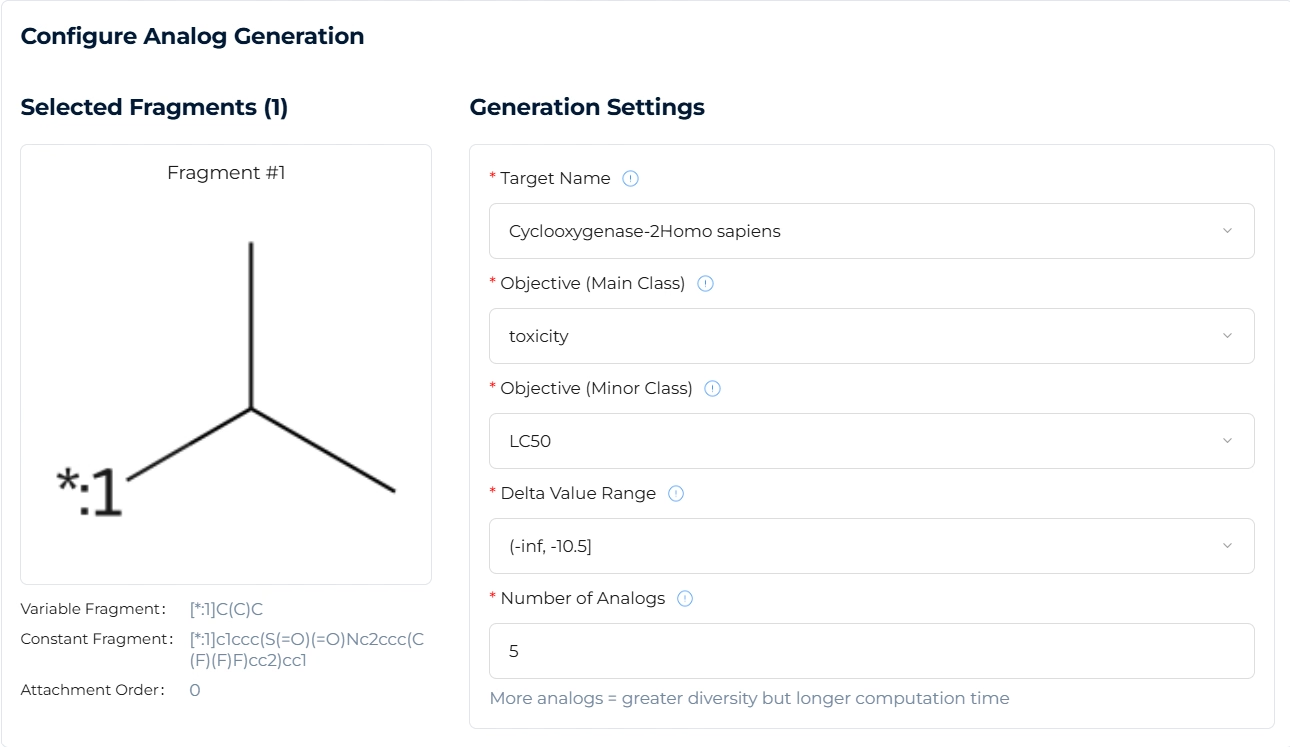
AlanMolecularAI™ can identify molecular fragments within the starting compound and allow the user to define which structural region should be varied.
A constant fragment can be retained while a variable fragment is selected for analog generation. This allows chemical exploration to remain focused around a scaffold or structural feature considered important to the project.

3. Define the Target and Optimization Objective
Users can configure the molecular generation task according to the biological target, optimization objective, desired value range, and number of analogs.
Depending on the available models and project configuration, optimization objectives can include target-related activity, toxicity, ADMET-related properties, and other molecular characteristics.
This enables candidate generation to be directed toward a defined research objective rather than simply producing random structural variations.
4. Generate and Evaluate Molecular Analogs
AlanMolecularAI™ generates structural analogs that preserve the selected molecular framework while introducing controlled modifications to the variable region.
Generated candidates can be compared using molecular descriptors and predictive properties such as:
Molecular weight (MolWt)
Topological polar surface area (TPSA)
Lipophilicity-related descriptors such as SLogP
Synthetic accessibility (SA)
Quantitative estimate of drug-likeness (QED)
Target- or project-specific predicted properties
This allows researchers to compare both chemical structure and predicted molecular profile when selecting candidates for further investigation.

How AlanMolecularAI™ Evaluates Candidates
Small-molecule optimization is rarely a single-property problem. Improving one characteristic can negatively affect another, making multi-parameter evaluation important during lead optimization.
AlanMolecularAI™ is designed to compare generated molecules across several computational dimensions rather than relying on one isolated prediction.
| Evaluation Area | Role in Molecular Optimization |
| Structural Similarity & Scaffold Retention | Controls how closely generated analogs remain related to the molecular starting point |
| Target-Related Prediction | Supports prioritization of compounds according to the selected biological target |
| ADMET-Related Properties | Evaluates selected absorption, distribution, metabolism, excretion, or toxicity-related endpoints |
| Physicochemical Properties | Compares descriptors such as molecular weight, TPSA, and lipophilicity |
| Drug-Likeness | Provides additional information for comparing candidate molecular profiles |
| Synthetic Accessibility | Supports assessment of whether proposed structures may be practical candidates for chemical synthesis |
Technology Behind AlanMolecularAI™
AlanMolecularAI™ uses a proprietary molecular optimization framework built from target–compound information and molecular property models.
The current platform architecture incorporates a molecular optimization model trained using data covering 50,000+ biological targets and associated active compounds, together with focused datasets and predictive models used during candidate evaluation.
| Component | Role in AlanMolecularAI™ |
| Molecular Optimization Model | Generates and optimizes molecular structures according to project objectives |
| Focused Target Data | Provides target-specific information for molecular design and optimization |
| ADMET Models | Evaluate selected pharmacokinetic and safety-related properties |
| SAR Analysis | Supports interpretation of relationships between structural changes and predicted activity |
| Property Prediction | Provides molecular descriptors and computational candidate profiles |
| Docking Integration | Allows selected candidates to proceed to structural target-interaction analysis |
What Does AlanMolecularAI™ Deliver?
| Deliverable | Description |
| Generated Molecular Analogs | New chemical structures derived from the selected molecular starting point |
| SMILES & 2D Structures | Machine-readable molecular representations and visual chemical structures |
| Molecular Descriptors | Properties such as molecular weight, TPSA, SLogP, SA, and QED |
| Predicted Properties | Target- and project-specific computational predictions where available |
| Candidate Comparison | Side-by-side evaluation of generated molecular analogs |
| Prioritized Candidates | A focused set of compounds for downstream docking, synthesis, or experimental testing |
Applications of AlanMolecularAI™
Hit-to-Lead Optimization
Start from an existing hit or active molecular scaffold and explore structural analogs that may provide improved predicted properties while retaining important chemical features.
Lead Optimization
Explore structural modifications around an existing lead while balancing target-related predictions, physicochemical properties, ADMET-related endpoints, and synthetic accessibility.
Analog Generation
Generate focused analog series around a selected scaffold or molecular fragment for medicinal chemistry and structure–activity relationship studies.
ADMET-Oriented Molecular Optimization
Use predictive models to identify molecular modifications that may improve selected ADMET-related properties before committing compounds to synthesis and experimental testing.
Structure–Activity Relationship Exploration
Compare changes in molecular structure with predicted activity and molecular-property profiles to support SAR hypothesis generation and compound prioritization.
From Molecular Generation to Docking
Selected AlanMolecularAI™ candidates can proceed directly to AlanDockAI™ for molecular docking and structural interaction analysis.
Starting Molecule → Fragment Selection → AI Optimization → Candidate Generation → Property Evaluation → AlanDockAI™ → Experimental Validation
This connection allows molecular generation and structural target evaluation to operate as complementary stages of the same computational drug-discovery workflow.
Understanding AlanMolecularAI™ Predictions
AlanMolecularAI™ is a computational molecular design and candidate-prioritization platform.
Predicted activity, ADMET properties, molecular descriptors, docking results, and candidate rankings are computational estimates and should not be interpreted as experimentally measured pharmacological or biological properties.
Compound synthesis and experimental validation remain necessary to confirm molecular activity, selectivity, ADMET behavior, and biological performance.
Related Alan Scientific AI Platforms
AlanMolecularAI™ is part of Alan Scientific's integrated suite of AI-assisted molecular and peptide design technologies.
AlanPepAI™
AI-assisted linear peptide design, sequence optimization, structural evaluation,
and candidate prioritization.
AlanDockAI™
Automated small-molecule docking and molecular interaction analysis.
HighFoldAI™
AI-assisted cyclic peptide design, structural prediction, and candidate evaluation.
Start an AlanMolecularAI™ Project
To begin a molecular generation or optimization project, provide a starting molecular structure, target information, optimization objective, and relevant project constraints.
AlanMolecularAI™ can then generate and evaluate structural analogs for downstream prioritization, docking, synthesis, and experimental validation.
Each molecular generation or optimization project currently requires 50 credits.
Start AlanMolecularAI™
1. Purpose
This document outlines the confidentiality obligations for users of the Alan Scientific platform.
2. User Confidentiality Undertaking
You acknowledge that the Alan Scientific platform, including its AI models, algorithms, software, and
interfaces, constitutes proprietary and confidential information. You agree not to disclose, reverse
engineer, or misuse these elements.
3. Our Data Handling Commitment
We will treat the non-public data you input into the platform as confidential. This data will be used
solely to provide the service to you. We implement industry-standard security measures to protect your
data.
4. Permitted Use of Data
We retain the right to use anonymized and aggregated data to train and improve our AI models. This
process
ensures your confidential information cannot be identified.
5. Prohibited Data
You are prohibited from uploading protected health information (PHI) or other specially categorized
personal data. The service is intended for research data only.
6. Liability
Alan Scientific's liability regarding data confidentiality is governed by our Terms of Service. We are
not
liable for indirect or consequential damages.
7. Contact
For questions regarding this policy, contact: [[email protected]].