AlanDockAI™ is a computational platform for protein–ligand molecular docking, virtual screening, and structural interaction analysis. It allows researchers to dock single compounds or multiple small molecules against a target protein, compare predicted binding poses, rank compounds by docking results, and inspect protein–ligand interactions in an interactive 3D environment.
AlanDockAI™ can be used independently or together with AlanMolecularAI™, allowing AI-generated molecular candidates to proceed directly into structure-based docking and candidate evaluation.
The goal is to help researchers move from a large set of candidate molecules to a focused group of compounds for further computational analysis, synthesis, procurement, and experimental validation.

What Can AlanDockAI™ Do?
| Research Need | AlanDockAI™ Approach | Output |
| Dock a Small Molecule | Dock a ligand against a defined protein target and search region | Predicted binding poses and docking score |
| Compare Multiple Compounds | Submit multiple ligand SMILES for batch molecular docking | Ranked compound results |
| Evaluate Binding Modes | Generate predicted protein–ligand complex conformations | 3D docking poses |
| Define a Binding Site | Configure docking-center coordinates and search-box dimensions | Targeted structure-based docking |
| Analyze Molecular Interactions | Inspect ligand orientation and nearby protein residues | Interactive structural analysis |
| Prioritize Candidate Molecules | Compare docking results across a compound set | Shortlisted candidates for downstream research |
AlanDockAI™ Workflow
1. Upload the Protein Target and Ligands
A docking project begins with a protein target structure and one or more small-molecule ligands.
Users can upload a prepared protein target and enter ligand structures using SMILES. Multiple ligands can be added to the same task for batch comparison.

2. Configure Molecular Docking Parameters
AlanDockAI™ allows users to configure parameters that control the docking search and the region of the protein explored during docking.
Available settings include:
Docking exhaustiveness
Maximum number of predicted poses
Ligand protonation pH range
Parallel computation jobs
Docking-center X, Y, and Z coordinates
Search-box X, Y, and Z dimensions
This allows docking to be focused on a known or proposed binding pocket while providing control over search thoroughness and the number of candidate conformations.

3. Run Protein–Ligand Docking
AlanDockAI™ explores potential ligand conformations and orientations within the defined protein binding region.
For batch projects, multiple small molecules can be processed within the same workflow, allowing candidate compounds to be evaluated under consistent docking conditions.
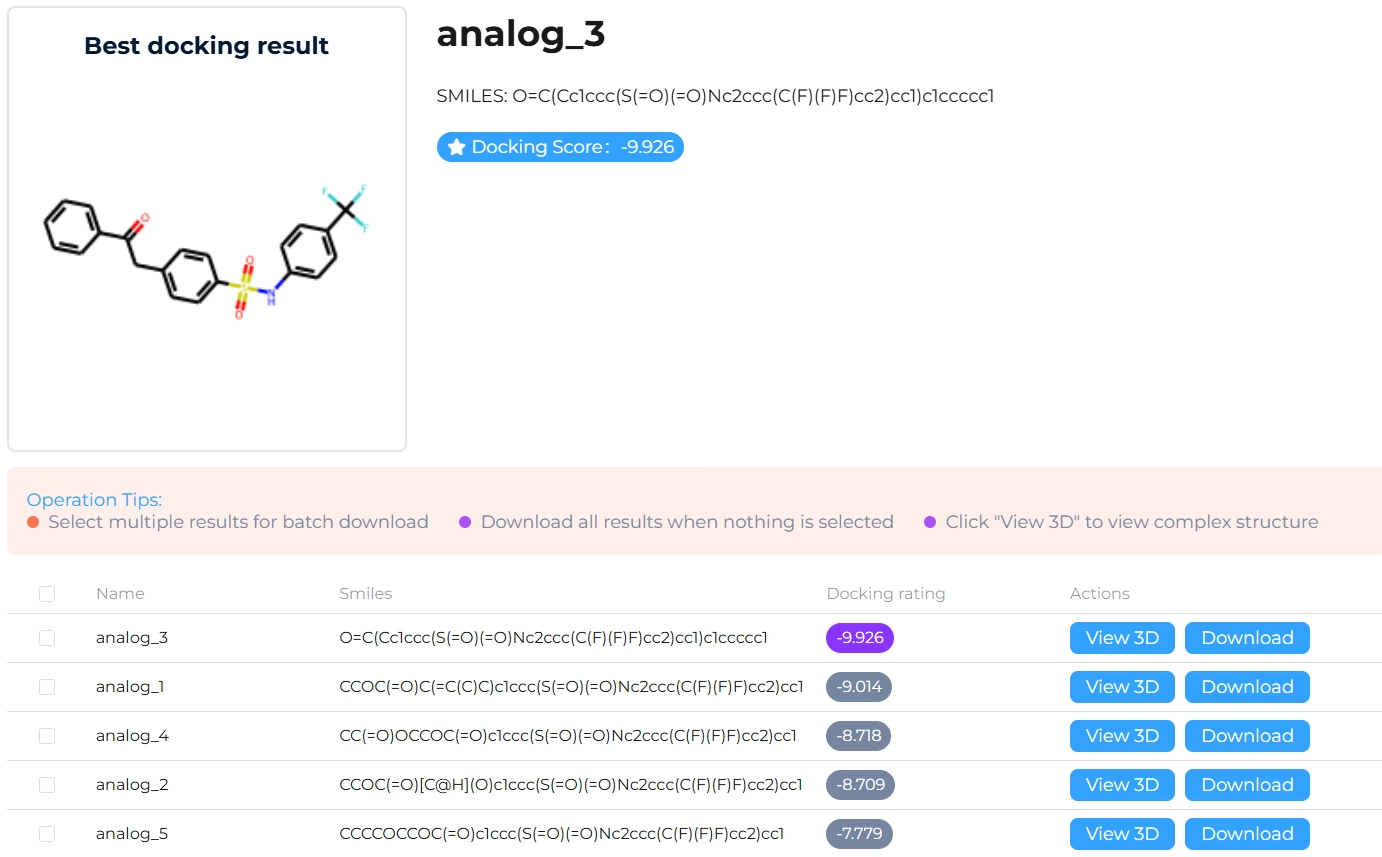
4. Rank Docking Results
Completed compounds are organized according to their predicted docking results, allowing researchers to compare candidate molecules and identify structures for closer inspection.
The result page provides the ligand structure, SMILES representation, docking score, and access to individual 3D complex structures.
5. Inspect the Protein–Ligand Complex in 3D
Selected docking results can be opened in an interactive 3D protein–ligand viewer.
Researchers can inspect the predicted ligand orientation, protein binding pocket, nearby amino acid residues, molecular surfaces, protein chains, and the spatial relationship between the ligand and surrounding residues.
This structural view helps determine whether a high-ranked docking result also shows a chemically and biologically reasonable binding mode.

Docking Inputs and Outputs
| Category | AlanDockAI™ |
| Protein Input | Prepared protein target structure, including PDBQT-compatible input |
| Ligand Input | Single or multiple small molecules represented by SMILES |
| Binding-Site Definition | Docking-center coordinates and adjustable 3D search box |
| Docking Configuration | Exhaustiveness, number of poses, pH range, and parallel jobs |
| Primary Results | Predicted docking poses and docking scores |
| Candidate Comparison | Ranked docking results across multiple ligands |
| Structural Analysis | Interactive 3D protein–ligand complex visualization |
| Result Export | Individual or batch result download |
How AlanDockAI™ Supports Virtual Screening
Virtual screening often requires researchers to compare many compounds against the same protein target. AlanDockAI™ supports batch molecular docking so that multiple candidate structures can be evaluated using a consistent target and docking configuration.
This workflow can be used to narrow a larger compound set into a smaller group of candidates for more detailed computational evaluation or experimental testing.
Protein Target → Compound Library → Molecular Docking → Result Ranking → 3D Interaction Analysis → Candidate Prioritization
Applications of AlanDockAI™
Structure-Based Drug Design
Evaluate how small molecules may interact with a known or predicted protein structure and use predicted binding modes to support compound-design hypotheses.
Virtual Screening
Dock multiple molecules against the same target to prioritize compounds for more detailed computational or experimental evaluation.
Hit Prioritization
Compare docking results among candidate hits and identify compounds with predicted binding modes that warrant further investigation.
Lead Optimization
Compare related molecular analogs to examine how structural changes may alter predicted ligand orientation and target interactions.
Binding-Site Analysis
Inspect predicted ligand poses within a defined protein pocket and evaluate the relationship between candidate molecules and nearby amino acid residues.
AlanMolecularAI™ + AlanDockAI™
AlanDockAI™ is designed to work together with AlanMolecularAI™.
AlanMolecularAI™ can generate and optimize structural analogs around a starting compound, while AlanDockAI™ provides a structure-based method for evaluating those candidates against a protein target.
Starting Molecule → AlanMolecularAI™ → Generated Analogs → AlanDockAI™ → Docking & 3D Analysis → Candidate Selection
Combining molecular generation with docking provides complementary information for candidate prioritization before compounds proceed to synthesis or experimental testing.
Understanding Molecular Docking Results
AlanDockAI™ is a computational molecular docking and candidate-prioritization platform.
A docking score is a computational estimate used to compare predicted ligand poses under a particular docking model. It should not be interpreted as a direct experimental measurement of binding affinity.
Similarly, a predicted binding pose represents a computational hypothesis of how a ligand may interact with the target protein.
Docking results should therefore be interpreted together with structural analysis and validated experimentally whenever biological conclusions are required.
Related Alan Scientific AI Platforms
AlanDockAI™ is part of Alan Scientific's integrated suite of AI-assisted molecular and peptide design technologies.
AlanMolecularAI™
AI-assisted small-molecule generation, analog design, property optimization,
and candidate prioritization.
AlanPepAI™
AI-assisted linear peptide design, sequence optimization, structural evaluation,
and peptide candidate prioritization.
HighFoldAI™
AI-assisted cyclic peptide design, structural prediction, and candidate evaluation.
Start an AlanDockAI™ Project
To begin a docking project, provide a prepared protein target structure and one or more small-molecule structures.
Configure the binding-site search region and docking parameters, run the molecular docking task, and compare predicted binding poses and docking scores directly within AlanDockAI™.
Current platform cost: 10 credits per small-molecule docking task.
Start AlanDockAI™
1. Purpose
This document outlines the confidentiality obligations for users of the Alan Scientific platform.
2. User Confidentiality Undertaking
You acknowledge that the Alan Scientific platform, including its AI models, algorithms, software, and
interfaces, constitutes proprietary and confidential information. You agree not to disclose, reverse
engineer, or misuse these elements.
3. Our Data Handling Commitment
We will treat the non-public data you input into the platform as confidential. This data will be used
solely to provide the service to you. We implement industry-standard security measures to protect your
data.
4. Permitted Use of Data
We retain the right to use anonymized and aggregated data to train and improve our AI models. This
process
ensures your confidential information cannot be identified.
5. Prohibited Data
You are prohibited from uploading protected health information (PHI) or other specially categorized
personal data. The service is intended for research data only.
6. Liability
Alan Scientific's liability regarding data confidentiality is governed by our Terms of Service. We are
not
liable for indirect or consequential damages.
7. Contact
For questions regarding this policy, contact: [[email protected]].