Online AI Tool for Cyclic Peptide Design
HighFoldAI™ is an AI-assisted platform for cyclic peptide design, sequence generation, and structural evaluation. Starting from a core peptide sequence or functional motif, HighFoldAI™ generates cyclic peptide candidates and evaluates their predicted structures and physicochemical properties before experimental synthesis.
The platform combines the HighFold-C2C sequence-generation workflow with structure prediction and multi-parameter peptide evaluation to help researchers explore cyclic peptide sequence space more efficiently.
The objective is to reduce a large computational design space into a focused set of cyclic peptide candidates for synthesis and experimental validation.

What Can HighFoldAI™ Do?
| Research Need | HighFoldAI™ Approach | Output |
| Design Cyclic Peptides | Generate cyclic peptide candidates around a defined core sequence | Novel cyclic peptide sequences |
| Preserve a Core Motif | Use an existing functional peptide sequence as the design starting point | Candidates retaining the selected core motif |
| Explore Different Loop Sizes | Adjust the span length used during cyclic peptide generation | Candidate designs with different sequence lengths and cyclic architectures |
| Evaluate Predicted Structures | Apply structure-prediction models to generated peptide candidates | Predicted 3D peptide structures and confidence metrics |
| Compare Peptide Properties | Calculate multiple sequence and physicochemical descriptors | Comparative candidate profiles |
| Prioritize Candidates | Compare sequence, predicted structure, confidence, and molecular properties | Shortlisted cyclic peptides for synthesis and testing |
HighFoldAI™ Workflow
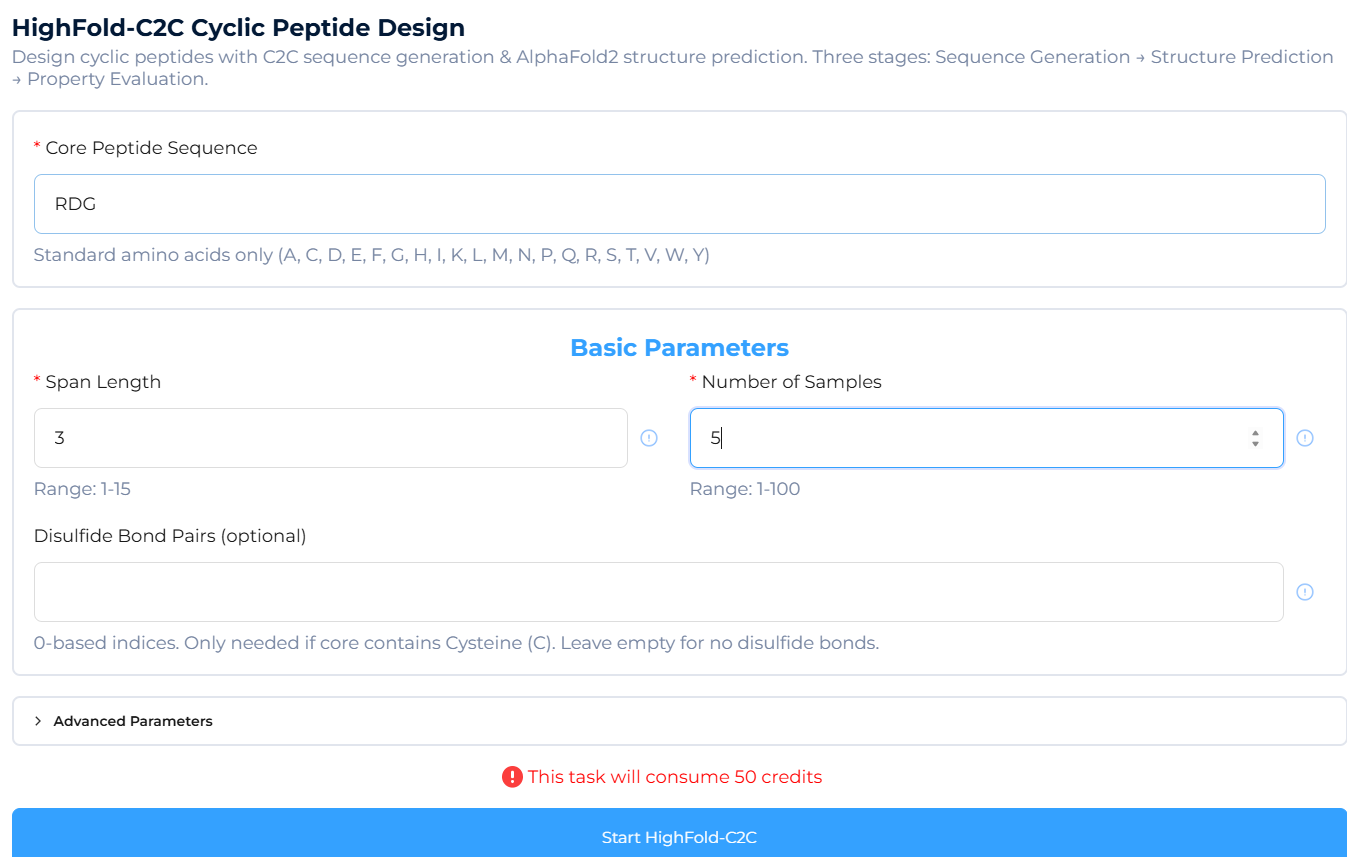
1. Define the Core Peptide Sequence
A HighFoldAI™ project begins with a core peptide sequence that represents the motif or sequence region the researcher wants to preserve during cyclic peptide design.
Users then define the Span Length, which controls the additional sequence space explored around the core peptide, together with the number of candidates to generate.
For sequences containing cysteine, optional disulfide-bond pairs can also be specified when appropriate for the desired peptide design.
2. Generate Cyclic Peptide Candidates
The HighFold-C2C workflow generates alternative peptide sequences around the selected core motif according to the chosen design parameters.
The objective is to explore sequence alternatives while maintaining the core peptide information supplied by the researcher.
Advanced generation parameters can also be adjusted to control candidate diversity and sampling behavior.
3. Predict Candidate Structures
Generated sequences proceed to AI-based peptide structure prediction. HighFoldAI™ currently integrates AlphaFold-based structural modeling workflows to generate candidate 3D structures.
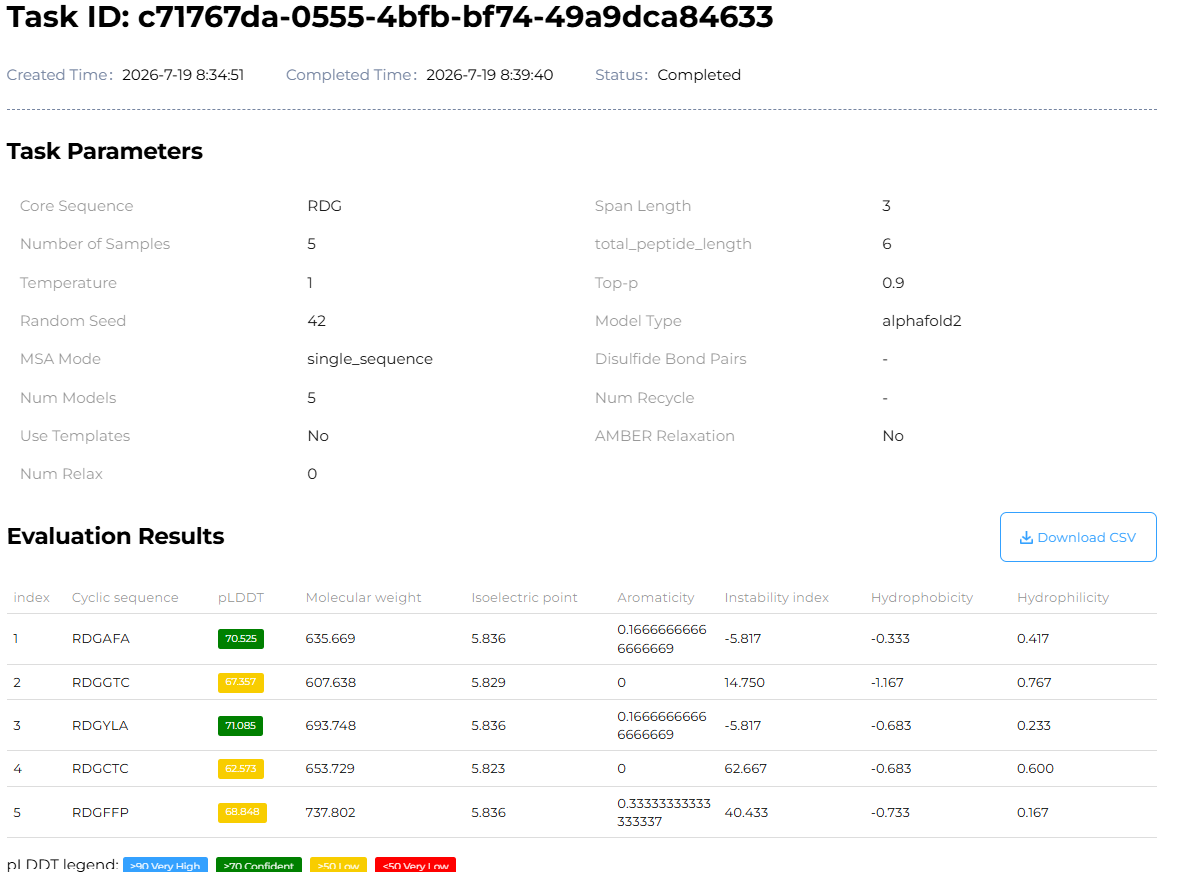
Each predicted model can be accompanied by a pLDDT confidence score, which provides information about confidence in the predicted local structure.
pLDDT is a model-confidence metric and should not be interpreted as an experimental measurement of peptide stability or biological activity.
4. Evaluate Physicochemical Properties
HighFoldAI™ calculates multiple peptide descriptors so that generated sequences can be compared beyond structure prediction alone.
Current candidate outputs can include:
Predicted cyclic peptide sequence
pLDDT confidence score
Molecular weight
Isoelectric point
Aromaticity
Instability index
Hydrophobicity
Hydrophilicity
This multi-parameter view allows researchers to compare candidates according to both predicted structural confidence and peptide physicochemical characteristics.
5. Review and Download Predicted Structures
For each generated cyclic peptide, HighFoldAI™ can produce multiple predicted 3D structural models.
Selected structures can be viewed directly in the platform or downloaded as PDB files for additional computational analysis.

6. Inspect Cyclic Peptide Structures in 3D
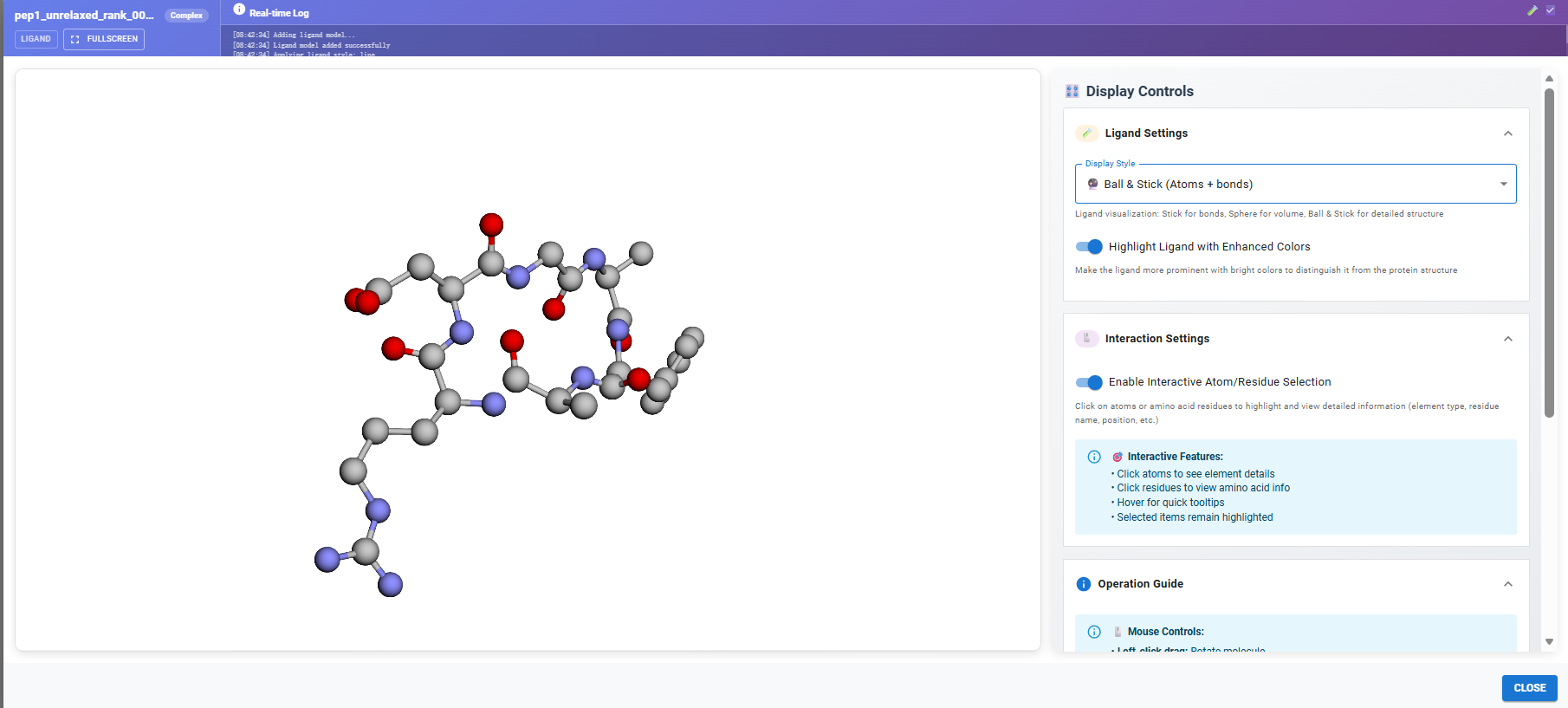
HighFoldAI™ includes an interactive 3D molecular viewer for examining predicted cyclic peptide conformations.
Researchers can rotate and inspect individual structures, visualize atoms and bonds, and compare predicted conformational features among candidate peptides.
HighFoldAI™ Inputs and Outputs
| Category | HighFoldAI™ |
| Core Input | Peptide sequence using standard amino acid codes |
| Design Parameter | Span Length for cyclic peptide generation |
| Candidate Number | User-defined number of generated peptide samples |
| Optional Constraint | Defined disulfide-bond pairs for compatible cysteine-containing sequences |
| Sequence Output | Generated cyclic peptide candidate sequences |
| Structural Output | Predicted 3D peptide structures and PDB files |
| Confidence Metric | pLDDT structural prediction confidence |
| Property Evaluation | Molecular weight, pI, aromaticity, instability, hydrophobicity, and hydrophilicity |
| Visualization | Interactive 3D structure viewer |
| Data Export | Candidate-property CSV and predicted PDB structures |
Applications of HighFoldAI™
Cyclic Peptide Lead Design
Generate alternative cyclic peptide candidates around a known or proposed peptide motif and prioritize sequences for experimental synthesis.
Peptide Sequence Optimization
Explore changes in residues surrounding a core peptide sequence while comparing predicted structural confidence and physicochemical properties.
Cyclic Peptide Structure Exploration
Generate and compare predicted 3D conformations to support structural hypotheses before committing multiple peptide candidates to synthesis.
Candidate Prioritization
Use sequence, structural-confidence, and physicochemical information to reduce a larger generated library to a smaller group of candidates for experimental evaluation.
HighFoldAI™ + Custom Peptide Synthesis
HighFoldAI™ connects computational cyclic peptide design with Alan Scientific's Custom Peptide Synthesis capabilities.
Selected cyclic peptide candidates can proceed from computational design into physical peptide synthesis, purification, quality control, and experimental testing.
Core Peptide → HighFoldAI™ Design → Cyclic Candidate Generation → Structure Prediction → Candidate Prioritization → Peptide Synthesis → Experimental Validation
This connection helps researchers move from computational cyclic peptide concepts to experimentally testable peptide candidates within a coordinated workflow.
HighFoldAI™ vs AlanPepAI™
| Platform | Primary Focus |
| AlanPepAI™ | Linear peptide design, sequence optimization, peptide–target modeling, and candidate ranking |
| HighFoldAI™ | Cyclic peptide generation, structure prediction, physicochemical evaluation, and candidate prioritization |
Researchers working with an existing linear peptide and a protein target may begin with AlanPepAI™, while projects focused specifically on generating and evaluating cyclic peptide architectures can use HighFoldAI™.
Understanding HighFoldAI™ Predictions
HighFoldAI™ is a computational cyclic peptide design and candidate-prioritization platform.
Predicted peptide structures, pLDDT values, instability indices, hydrophobicity values, and other computational descriptors are model-derived estimates. They should not be interpreted as experimentally measured peptide stability, solubility, binding affinity, pharmacokinetics, or biological activity.
Peptide synthesis and experimental validation remain necessary to confirm the structural and biological performance of HighFoldAI™ candidates.
Related Alan Scientific AI Platforms
HighFoldAI™ is part of Alan Scientific's integrated suite of AI-assisted molecular and peptide design technologies.
AlanPepAI™
AI-assisted linear peptide design, sequence optimization, docking,
and candidate prioritization.
AlanMolecularAI™
AI-assisted small-molecule generation, analog design, property optimization,
and candidate prioritization.
AlanDockAI™
Protein–ligand molecular docking, virtual screening, and interactive
structural analysis.
Start a HighFoldAI™ Project
To begin a cyclic peptide design project, provide a core peptide sequence and select the desired Span Length, number of candidates, and optional structural constraints.
HighFoldAI™ can then generate and evaluate cyclic peptide candidates for downstream prioritization, synthesis, and experimental validation.
Current platform cost: 50 credits per HighFoldAI™ project.
Start HighFoldAI™
1. Purpose
This document outlines the confidentiality obligations for users of the Alan Scientific platform.
2. User Confidentiality Undertaking
You acknowledge that the Alan Scientific platform, including its AI models, algorithms, software, and
interfaces, constitutes proprietary and confidential information. You agree not to disclose, reverse
engineer, or misuse these elements.
3. Our Data Handling Commitment
We will treat the non-public data you input into the platform as confidential. This data will be used
solely to provide the service to you. We implement industry-standard security measures to protect your
data.
4. Permitted Use of Data
We retain the right to use anonymized and aggregated data to train and improve our AI models. This
process
ensures your confidential information cannot be identified.
5. Prohibited Data
You are prohibited from uploading protected health information (PHI) or other specially categorized
personal data. The service is intended for research data only.
6. Liability
Alan Scientific's liability regarding data confidentiality is governed by our Terms of Service. We are
not
liable for indirect or consequential damages.
7. Contact
For questions regarding this policy, contact: [[email protected]].