How to Order Custom Peptides for Research
Prepare a custom peptide synthesis request with clear sequence, modification, purity, quantity and QC requirements for your research project.
To order custom peptides, define the complete molecular structure, quantity basis, purity requirement and intended experiment. Include any required counterion, analytical tests and delivery format. A sequence alone leaves important choices unresolved, especially for modified peptides and quantitative assays.
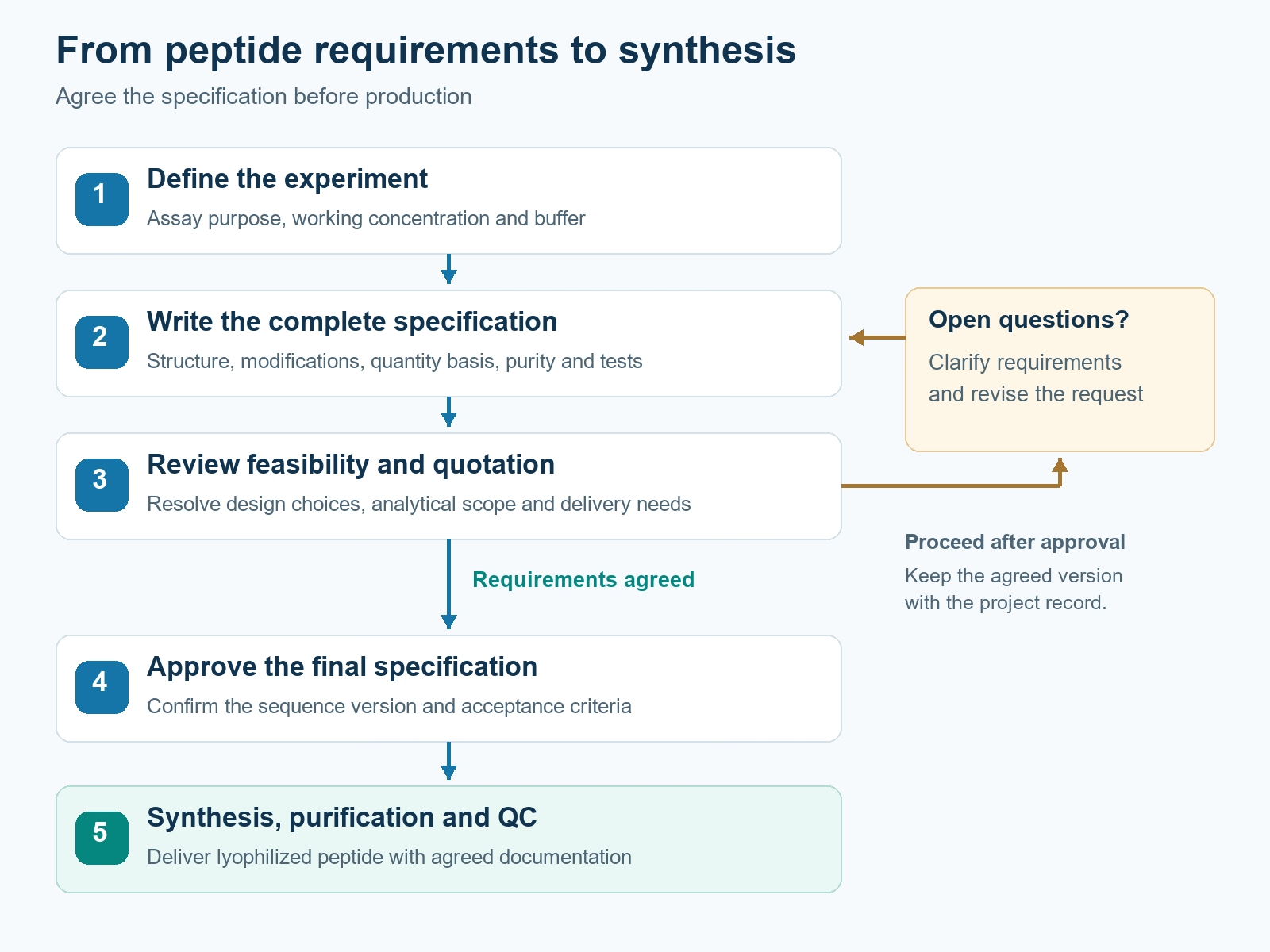
A useful request separates fixed requirements from questions that need technical review. If a specification is undecided, explain the experiment and mark that item for discussion before production.
Start with the experiment and the complete structure
Describe what the peptide will do in your study: act as a binding ligand, enzyme substrate, antigen, reference compound or screening candidate. Add the planned working concentration and buffer if known. These details help focus the discussion on requirements that could affect interpretation.
Write the sequence from the N-terminus to the C-terminus using either standard single-letter or three-letter amino acid codes. Both formats are acceptable. State both terminal groups explicitly and identify residue stereochemistry. For a sequence containing standard L-amino acids and glycine, H–AGKSF–OH and H–Ala–Gly–Lys–Ser–Phe–OH describe the same peptide. Ac–AGKSF–NH₂ contains the same five residues with an acetylated N-terminus and an amidated C-terminus. These are illustrative structures, not a recommended assay peptide.
Identify D-residues, noncanonical amino acids and modifications by position. Define any nonstandard notation explicitly; do not rely on letter case alone to indicate stereochemistry. For example, a lowercase letter intended to indicate a D-residue should be accompanied by its residue identity and position. For a cyclic peptide, specify the residues and functional groups forming the linkage. For multiple disulfides, provide the intended cysteine pairing. Attach a structure when text notation could be ambiguous. Supplier design guidance also emphasizes evaluating the complete sequence and its feasibility before committing to synthesis. Bachem Peptide Guide.
We recommend separating the required structure from changes you would consider during feasibility review. If a terminal group, residue or attachment site must remain unchanged, say so explicitly. This gives the synthesis team a clear boundary for discussing alternatives.
Specify what “modified peptide” means
A request for a “biotinylated peptide” or “fluorescent peptide” needs more detail before the final structure can be agreed. Include the label identity, attachment position and linker, where applicable. Distinguish an N-terminal modification from a side-chain modification.
For example, “N-terminal biotin, no spacer, C-terminal amide” is more specific than “biotin peptide.” If the labeling site is still open, identify the region that must remain accessible and describe the assay format. Available modification types and their chemistry differ; the Thermo Fisher custom peptide synthesis brochure illustrates why terminal groups, labels and conjugation should be specified separately.
If your experimental design calls for an unlabeled comparator or another control, list it as a separate sequence with its own specifications. A statement such as “same peptide without the label” should still be translated into a complete structure before ordering.
Define purity and quantity as separate requirements
State the requested chromatographic purity, then specify how much material is needed and what that quantity represents.
Gross weight includes the peptide material and other components such as water and counterions. HPLC area purity and peptide content describe different properties; an HPLC purity result does not by itself assign the target peptide mass in the vial. Sigma-Aldrich, Peptide Quick Tips.
For a peptide panel, distinguish the amount per sequence from the total order. “5 mg per peptide for 12 sequences” removes an ambiguity that “60 mg peptide library” leaves unresolved.
We recommend agreeing on the quantity basis before comparing quotations, particularly when the experiment depends on accurate concentration. State whether the requested amount is gross lyophilized material or material on a specified content basis. If content determination is needed, agree on the method and the meaning of the reported result.
Our peptide quantity and content guide explains these distinctions and the limits of purity-based calculations.
Turn special requirements into measurable specifications
Avoid relying on terms such as “high quality,” “TFA-free” or “suitable for cells” without explaining the intended requirement.
If the protocol specifies acetate or hydrochloride, name the required salt form. If residual TFA matters, request an agreed limit, reporting basis and analytical method. Salt-form selection and residual-TFA measurement are related but distinct decisions; our TFA removal and counterion guide covers when these specifications are useful.
For a solubility assessment, identify the solvent or buffer and target concentration. For an endotoxin requirement, provide the limit and units, or explain the application if the limit still needs to be established.
HPLC, mass spectrometry, peptide-content determination and endotoxin testing answer different questions. Supplier analytical menus list these separately because one result does not replace the others. Eurogentec, Custom Peptides: QC Testing.
We recommend making each mandatory acceptance criterion explicit before synthesis. Identify the measurement, required result and documentation needed. Mark optional tests separately so the quotation can distinguish essential requirements from additional characterization.
A specification sheet for your quotation request
Use the following fields for each peptide. “For technical review” is a useful entry when a decision remains open.
| Field | Information to provide |
|---|---|
| Project and peptide ID | A unique identifier for each sequence and version |
| Intended experiment | Assay type, purpose and relevant reference protocol |
| Complete sequence | N-to-C sequence, terminal groups and residue stereochemistry |
| Modifications | Modification identity, position, linker and required connectivity |
| Quantity | Amount per peptide; gross-weight or specified content basis |
| Purity | Requested chromatographic purity and any method requirements |
| Counterion | Required salt form and any separately specified residual-TFA limit |
| Additional testing | Required measurement, conditions, limit and units |
| Delivery format | Lyophilized powder; requested vial count and amount per vial for review |
| Documentation | Required QC data, COA and any project-specific results |
| Timing and destination | Required receipt date, delivery address and deadline flexibility |
| Open decisions | Questions requiring review and changes you would consider |
Before approving the quotation, check that the sequence version, modification sites, quantity basis and acceptance criteria match this sheet. For a revised design, use a new version identifier and explicitly state which earlier version it replaces.
Request custom peptide synthesis
We provides custom peptide synthesis for research projects, with lyophilized peptide delivery and paper and electronic QC documentation. Feasibility, purification and any additional testing are reviewed against the project requirements.
Email your sequence and specification sheet to [email protected]. Include unresolved design questions so the structure and delivery requirements can be agreed before synthesis.
Research use only. Not for human administration.